Small freeware programs for bulletin boards. I wrote them in Turbo
Pascal in the fall of 1994. A caller could run them while they were
on the board. They were the first software I put out.
"I thought every BBS should have one without having to pay extra."
The Windows Source
I ran them on my own board, the Windows Source, around Evansville.
RemoteAccess, three nodes, and a FrontDoor mailer. The main menu
called it "the HOME of CRAGWARE BBS software."
BBSUList, TagCheck, and FFind all landed between September 23 and
October 8. TagCheck ran at every logoff. BBSUList was the user
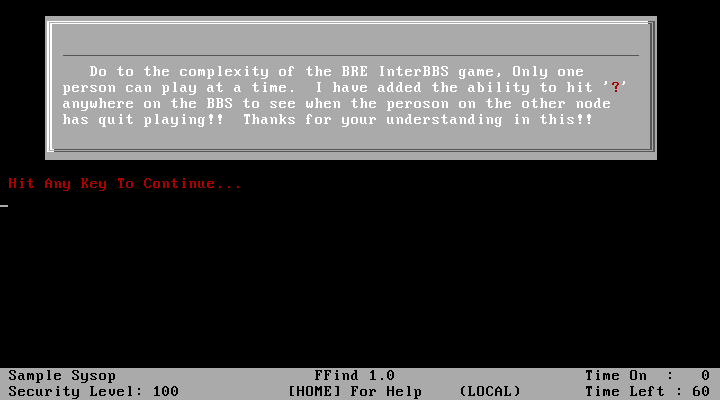
list. FFind kept Barren Realms Elite from opening on two nodes at
once.
A visiting sysop could hit ! anywhere for sysop support and the
CraigWare doors. Other systems could file-request CRAIG on the
FrontDoor line. That returned CRAIG.ZIP, a listing of the area,
rebuilt every night.
The banner carried the board number, 812-476-4534, and FidoNet
node 1:2310/2.
I wrote them with RMDoor 4.5a, a Pascal toolkit. It handled the
modem. I wrote the rest like a normal program. They read the drop files from the common BBS software, not
only RemoteAccess, and you drove them from the command line so they
could sit in someone else's menus.
The pictures below are those programs running. The names and the
files in them are made up.
TagCheck 1.1
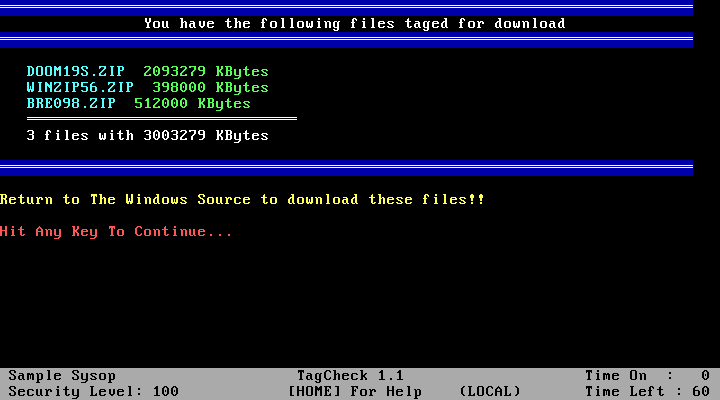
The notes are dated October 1, 1994. At logoff it read the list of
files a caller had tagged and not downloaded, then showed each file
and the size. It asked them to come back and get the files.
It labeled those sizes KBytes. They were bytes.
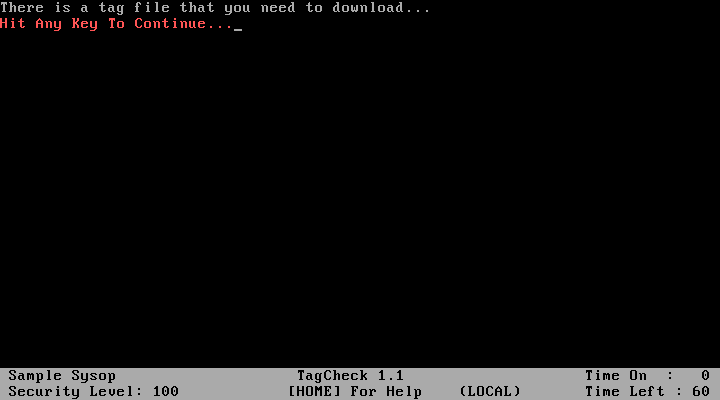
Point it at a text file and it showed that note instead of the
list. I used it that way from the goodbye menu.
TagCheck 1.1 at logoff. The files are samples. The sizes are
bytes, even though it says KBytes.
The same program, showing a short note instead of the file list.
BBSUList
A user list for RemoteAccess. Version 1.0 beta is dated September
23, 1994. What I still have is 1.3 beta, from October 8.
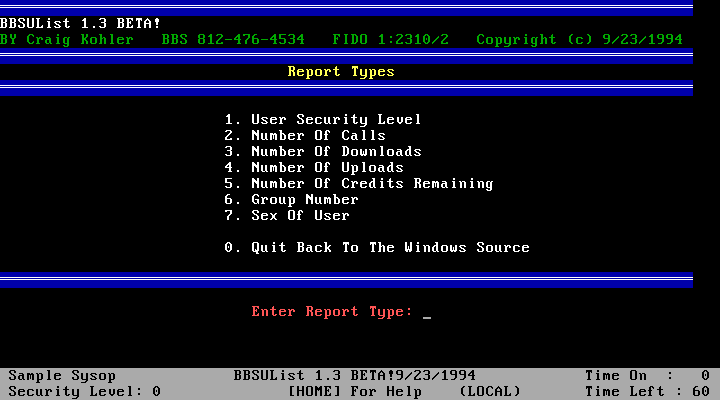
You could list people by security level, number of calls,
downloads, uploads, credits left, group, or sex. Short form or
long form.
BBSUList 1.3 beta. 812-476-4534 was the Windows Source phone
number.
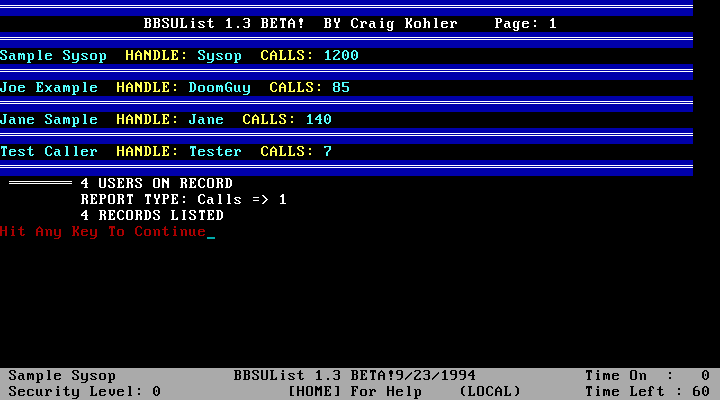
A calls report. Those names are made up.
FFind 1.0
A flag-file checker for batch files, from that same October.
You gave it a config, a file to look for, and a screen to show.
If the file was there, it showed the screen and set an errorlevel
so the batch file could stop.
On the Windows Source, that file meant someone was already in
Barren Realms Elite. FFind put up a note, and the second caller
did not get into the game.
FFind 1.0, with the note the board showed when the game was
already running on another node.
A list of other boards
I wrote a door for a list of other BBSes too. I don't have a
copy of that one. What I still have is the notes that went out
with TagCheck.
From those notes, it could add a board when a visiting sysop first
logged on. It could report, find, edit, export the list to a text
file or a printer, and pack the list so deleted boards drop out. It had
ANSI and RIP menus. The same command-line switches let you skip
its menu and use your own.
Downloads
These are the original 1994 DOS programs. They run in DOSBox.
They were free. The notes said you could re-zip them and pass them on.
Later, at American General
Years later, at American General, I wrote a utility that changed
the IP settings in the INI files on a DOS network boot disk. I
don't remember what I called it.